tespy.components.turbomachinery package
tespy.components.turbomachinery.base module
Module of class Turbomachine.
This file is part of project TESPy (github.com/oemof/tespy). It’s copyrighted by the contributors recorded in the version control history of the file, available from its original location tespy/components/turbomachinery/base.py
SPDX-License-Identifier: MIT
- class tespy.components.turbomachinery.base.Turbomachine(label, **kwargs)[source]
Bases:
ComponentParent class for compressor, pump and turbine.
Mandatory Equations
mass flow:
tespy.components.component.Component.variable_equality_structure_matrix()fluid:
tespy.components.component.Component.variable_equality_structure_matrix()
Optional Equations
Inlets/Outlets
in1
out1
- Parameters:
label (str) – The label of the component.
design (list) – List containing design parameters (stated as String).
offdesign (list) – List containing offdesign parameters (stated as String).
design_path (str) – Path to the components design case.
local_offdesign (boolean) – Treat this component in offdesign mode in a design calculation.
local_design (boolean) – Treat this component in design mode in an offdesign calculation.
char_warnings (boolean) – Ignore warnings on default characteristics usage for this component.
printout (boolean) – Include this component in the network’s results printout.
P (float, dict) – Power, \(P/\text{W}\)
pr (float, dict) – Outlet to inlet pressure ratio, \(pr/1\)
dp (float, dict) – Inlet to outlet pressure difference, \(dp/\text{p}_\text{unit}\) Is specified in the Network’s pressure unit
Example
For an example please refer to:
- bus_deriv(bus)[source]
Calculate partial derivatives of the bus function.
- Parameters:
bus (tespy.connections.bus.Bus) – TESPy bus object.
- Returns:
deriv (ndarray) – Matrix of partial derivatives.
- bus_func(bus)[source]
Calculate the value of the bus function.
- Parameters:
bus (tespy.connections.bus.Bus) – TESPy bus object.
- Returns:
residual (float) – Value of energy transfer \(\dot{E}\). This value is passed to
tespy.components.component.Component.calc_bus_value()for value manipulation according to the specified characteristic line of the bus.\[\dot{E} = \dot{m}_{in} \cdot \left(h_{out} - h_{in} \right)\]
- energy_balance_func()[source]
Calculate energy balance of a turbomachine.
- Returns:
residual (float) – Residual value of turbomachine energy balance
\[0=\dot{m}_{in}\cdot\left(h_{out}-h_{in}\right)-P\]
- entropy_balance()[source]
Calculate entropy balance of turbomachine.
Note
The entropy balance makes the follwing parameter available:
\[\begin{split}\text{S\_irr}=\dot{m} \cdot \left(s_\mathrm{out}-s_\mathrm{in} \right)\\\end{split}\]
- get_plotting_data()[source]
Generate a dictionary containing FluProDia plotting information.
- Returns:
data (dict) – A nested dictionary containing the keywords required by the
calc_individual_isolinemethod of theFluidPropertyDiagramclass. First level keys are the connection index (‘in1’ -> ‘out1’, therefore1etc.).
tespy.components.turbomachinery.compressor module
Module of class Compressor.
This file is part of project TESPy (github.com/oemof/tespy). It’s copyrighted by the contributors recorded in the version control history of the file, available from its original location tespy/components/turbomachinery/compressor.py
SPDX-License-Identifier: MIT
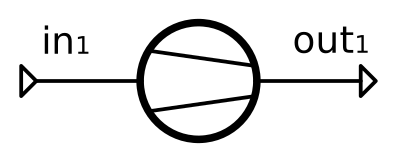
- class tespy.components.turbomachinery.compressor.Compressor(label, **kwargs)[source]
Bases:
TurbomachineClass for a basic compressor.
Mandatory Equations
fluid:
tespy.components.component.Component.variable_equality_structure_matrix()mass flow:
tespy.components.component.Component.variable_equality_structure_matrix()
Optional Equations
tespy.components.turbomachinery.base.Turbomachine.energy_balance_func()tespy.components.turbomachinery.compressor.Compressor.eta_s_func()tespy.components.turbomachinery.compressor.Compressor.eta_s_char_func()
Inlets/Outlets
in1
out1
Optional inlets
power
Image

- Parameters:
label (str) – The label of the component.
design (list) – List containing design parameters (stated as String).
offdesign (list) – List containing offdesign parameters (stated as String).
design_path (str) – Path to the components design case.
local_offdesign (boolean) – Treat this component in offdesign mode in a design calculation.
local_design (boolean) – Treat this component in design mode in an offdesign calculation.
char_warnings (boolean) – Ignore warnings on default characteristics usage for this component.
printout (boolean) – Include this component in the network’s results printout.
P (float, dict) – Power, \(P/\text{W}\)
eta_s (float, dict) – Isentropic efficiency, \(\eta_s/1\)
pr (float, dict) – Outlet to inlet pressure ratio, \(pr/1\)
dp (float, dict) – Inlet to outlet pressure difference, \(dp/\text{p}_\text{unit}\) Is specified in the Network’s pressure unit
eta_s_char (tespy.tools.characteristics.CharLine, dict) – Characteristic curve for isentropic efficiency, provide CharLine as function
func.
Example
Create an air compressor model and calculate the power required for compression of 50 l/s of ambient air to 5 bars.
>>> from tespy.components import Sink, Source, Compressor
>>> from tespy.connections import Connection
>>> from tespy.networks import Network
>>> import os
>>> nw = Network(iterinfo=False)
>>> nw.units.set_defaults(**{
...     "pressure": "bar", "temperature": "degC", "volumetric_flow": "l/s",
...     "enthalpy": "kJ/kg"
... })
>>> si = Sink('sink')
>>> so = Source('source')
>>> comp = Compressor('compressor')
>>> inc = Connection(so, 'out1', comp, 'in1')
>>> outg = Connection(comp, 'out1', si, 'in1')
>>> nw.add_conns(inc, outg)
Specify the compressor parameters: nominal efficiency and pressure ratio. For offdesign mode the efficiency characteristic line is selected instead of the isentropic efficiency.
>>> comp.set_attr(pr=5, eta_s=0.8, design=['eta_s'], offdesign=['eta_s_char'])
>>> inc.set_attr(fluid={'air': 1}, p=1, T=20, v=50)
>>> nw.solve('design')
>>> nw.save('tmp.json')
>>> round(comp.P.val, 0)
12772.0
>>> round(comp.eta_s.val, 2)
0.8
>>> inc.set_attr(v=45)
>>> nw.solve('offdesign', design_path='tmp.json')
>>> round(comp.eta_s.val, 2)
0.79
>>> os.remove('tmp.json')
- char_map_eta_s_func()[source]
Calculate isentropic efficiency from characteristic map.
- Returns:
residual (float) – Residual value of equation.
Note
X: speedline index (rotational speed is constant)
Y: nondimensional mass flow
igva: variable inlet guide vane angle for value manipulation according to [32].
\[\begin{split}X = \sqrt{\frac{T_\mathrm{in,design}}{T_\mathrm{in}}}\\ Y = \frac{\dot{m}_\mathrm{in} \cdot p_\mathrm{in,design}} {\dot{m}_\mathrm{in,design} \cdot p_\mathrm{in} \cdot X}\\ \vec{Y} = f\left(X,Y\right)\cdot\left(1-\frac{igva}{100}\right)\\ \vec{Z}=f\left(X,Y\right)\cdot\left(1-\frac{igva^2}{10000}\right)\\ 0 = \frac{\eta_\mathrm{s}}{\eta_\mathrm{s,design}} - f\left(Y,\vec{Y},\vec{Z}\right)\end{split}\]
- char_map_pr_func()[source]
Calculate pressure ratio from characteristic map.
- Returns:
residual (float) – Residual value of equations.
Note
X: speedline index (rotational speed is constant)
Y: nondimensional mass flow
igva: variable inlet guide vane angle for value manipulation according to [32].
\[\begin{split}X = \sqrt{\frac{T_\mathrm{in,design}}{T_\mathrm{in}}}\\ Y = \frac{\dot{m}_\mathrm{in} \cdot p_\mathrm{in,design}} {\dot{m}_\mathrm{in,design} \cdot p_\mathrm{in} \cdot X}\\ \vec{Y} = f\left(X,Y\right)\cdot\left(1-\frac{igva}{100}\right)\\ \vec{Z} = f\left(X,Y\right)\cdot\left(1-\frac{igva}{100}\right)\\ 0 = \frac{p_{out} \cdot p_{in,design}} {p_\mathrm{in} \cdot p_\mathrm{out,design}}- f\left(Y,\vec{Y},\vec{Z}\right)\end{split}\]
- convergence_check()[source]
Perform a convergence check.
Note
Manipulate enthalpies/pressure at inlet and outlet if not specified by user to match physically feasible constraints.
- energy_connector_balance_func()[source]
(optional) energy balance equation connecting the power connector to the component’s power
- Returns:
residual (float) – Residual value of equation
\[0=\dot E - \dot{m}_{in}\cdot\left(h_{out}-h_{in}\right)\]
- eta_s_char_func()[source]
Equation for given isentropic efficiency characteristic.
- Returns:
residual (float) – Residual value of equation.
\[0 = \left(h_{out}-h_{in}\right) \cdot \eta_{s,design} \cdot f\left( expr \right) -\left( h_{out,s} - h_{in} \right)\]
- eta_s_deriv(increment_filter, k, dependents=None)[source]
Partial derivatives for isentropic efficiency.
- Parameters:
increment_filter (ndarray) – Matrix for filtering non-changing variables.
k (int) – Position of derivatives in Jacobian matrix (k-th equation).
- eta_s_func()[source]
Equation for given isentropic efficiency of a compressor.
- Returns:
residual (float) – Residual value of equation.
\[0 = -\left( h_{out} - h_{in} \right) \cdot \eta_{s} + \left( h_{out,s} - h_{in} \right)\]
- exergy_balance(T0)[source]
Calculate exergy balance of a compressor.
- Parameters:
T0 (float) – Ambient temperature T0 / K.
Note
\[ \begin{align}\begin{aligned}\begin{split}\dot{E}_\mathrm{P} = \begin{cases} \dot{E}_\mathrm{out}^\mathrm{PH} - \dot{E}_\mathrm{in}^\mathrm{PH} & T_\mathrm{in}, T_\mathrm{out} \geq T_0\\ \dot{E}_\mathrm{out}^\mathrm{T} + \dot{E}_\mathrm{out}^\mathrm{M} - \dot{E}_\mathrm{in}^\mathrm{M} & T_\mathrm{out} > T_0 \leq T_\mathrm{in}\\ \dot{E}_\mathrm{out}^\mathrm{M} - \dot{E}_\mathrm{in}^\mathrm{M} & T_0 \geq T_\mathrm{in}, T_\mathrm{out}\\ \end{cases}\end{split}\\\begin{split}\dot{E}_\mathrm{F} = \begin{cases} P & T_\mathrm{in}, T_\mathrm{out} \geq T_0\\ P + \dot{E}_\mathrm{in}^\mathrm{T} & T_\mathrm{out} > T_0 \leq T_\mathrm{in}\\ P + \dot{E}_\mathrm{in}^\mathrm{T} -\dot{E}_\mathrm{out}^\mathrm{T} & T_0 \geq T_\mathrm{in}, T_\mathrm{out}\\ \end{cases}\end{split}\\\dot{E}_\mathrm{bus} = P\end{aligned}\end{align} \]
- static initialise_source(c, key)[source]
Return a starting value for pressure and enthalpy at outlet.
- Parameters:
c (tespy.connections.connection.Connection) – Connection to perform initialisation on.
key (str) – Fluid property to retrieve.
- Returns:
val (float) – Starting value for pressure/enthalpy in SI units.
- static initialise_target(c, key)[source]
Return a starting value for pressure and enthalpy at inlet.
- Parameters:
c (tespy.connections.connection.Connection) – Connection to perform initialisation on.
key (str) – Fluid property to retrieve.
- Returns:
val (float) – Starting value for pressure/enthalpy in SI units.
tespy.components.turbomachinery.polynomial_compressor module
- tespy.components.turbomachinery.polynomial_compressor.calc_EN12900(c: list, t_evap: float, t_cond: float) float[source]
- tespy.components.turbomachinery.polynomial_compressor.fit_EN12900(t_evap: array, t_cond: array, data: array) array[source]
tespy.components.turbomachinery.pump module
Module of class Pump.
This file is part of project TESPy (github.com/oemof/tespy). It’s copyrighted by the contributors recorded in the version control history of the file, available from its original location tespy/components/turbomachinery/pump.py
SPDX-License-Identifier: MIT
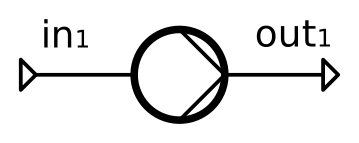
- class tespy.components.turbomachinery.pump.Pump(label, **kwargs)[source]
Bases:
TurbomachineClass for axial or radial pumps.
Mandatory Equations
fluid:
tespy.components.component.Component.variable_equality_structure_matrix()mass flow:
tespy.components.component.Component.variable_equality_structure_matrix()
Optional Equations
Inlets/Outlets
in1
out1
Optional inlets
power
Image

- Parameters:
label (str) – The label of the component.
design (list) – List containing design parameters (stated as String).
offdesign (list) – List containing offdesign parameters (stated as String).
design_path (str) – Path to the components design case.
local_offdesign (boolean) – Treat this component in offdesign mode in a design calculation.
local_design (boolean) – Treat this component in design mode in an offdesign calculation.
char_warnings (boolean) – Ignore warnings on default characteristics usage for this component.
printout (boolean) – Include this component in the network’s results printout.
P (float, dict) – Power, \(P/\text{W}\)
eta_s (float, dict) – Isentropic efficiency, \(\eta_s/1\)
pr (float, dict) – Outlet to inlet pressure ratio, \(pr/1\)
dp (float, dict) – Inlet to outlet pressure difference, \(dp/\text{p}_\text{unit}\) Is specified in the Network’s pressure unit
eta_s_char (tespy.tools.characteristics.CharLine, dict) – Characteristic curve for isentropic efficiency, provide CharLine as function
func.flow_char (tespy.tools.characteristics.CharLine, dict) – Characteristic curve for pressure rise as function of volumetric flow \(x/\frac{\text{m}^3}{\text{s}} \, y/\text{Pa}\).
Example
A pump with a known pump curve (difference pressure as function of volumetric flow) pumps 1,5 l/s of water in design conditions. E.g. for a given isentropic efficiency it is possible to calculate power consumption and pressure at the pump.
>>> from tespy.components import Sink, Source, Pump
>>> from tespy.connections import Connection
>>> from tespy.networks import Network
>>> from tespy.tools.characteristics import CharLine
>>> import os
>>> nw = Network(iterinfo=False)
>>> nw.units.set_defaults(**{
...     "pressure": "bar", "temperature": "degC", "volumetric_flow": "l/s", "enthalpy": "kJ/kg"
... })
>>> si = Sink('sink')
>>> so = Source('source')
>>> pu = Pump('pump')
>>> inc = Connection(so, 'out1', pu, 'in1')
>>> outg = Connection(pu, 'out1', si, 'in1')
>>> nw.add_conns(inc, outg)
After that we calculate offdesign performance using the pump curve and a characteristic function for the pump efficiency. We can calulate the offdesign efficiency and the volumetric flow, if the difference pressure changed. The default characteristc lines are to be found in the tespy.data module. Of course you are able to specify your own characteristcs, like done for the
flow_char. More information on how to specify characteristic functions are given in the corresponding part of the online documentation.>>> v = np.array([0, 0.4, 0.8, 1.2, 1.6, 2]) / 1000 >>> dp = np.array([15, 14, 12, 9, 5, 0]) * 1e5 >>> char = CharLine(x=v, y=dp) >>> pu.set_attr(eta_s=0.8, flow_char={'char_func': char, 'is_set': True}, ... design=['eta_s'], offdesign=['eta_s_char']) >>> inc.set_attr(fluid={'water': 1}, p=1, T=20, v=1.5, design=['v']) >>> nw.solve('design') >>> nw.save('tmp.json') >>> round(pu.pr.val, 0) 7.0 >>> round(outg.p.val - inc.p.val, 0) 6.0 >>> round(pu.P.val, 0) 1125.0 >>> outg.set_attr(p=12) >>> nw.solve('offdesign', design_path='tmp.json') >>> round(pu.eta_s.val, 2) 0.71 >>> round(inc.v.val, 1) 0.9 >>> os.remove('tmp.json')
- convergence_check()[source]
Perform a convergence check.
Note
Manipulate enthalpies/pressure at inlet and outlet if not specified by user to match physically feasible constraints.
- energy_connector_balance_func()[source]
(optional) energy balance equation connecting the power connector to the component’s power
- Returns:
residual (float) – Residual value of equation
\[0=\dot E - \dot{m}_{in}\cdot\left(h_{out}-h_{in}\right)\]
- eta_s_char_func()[source]
Equation for given isentropic efficiency characteristic.
- Returns:
residual (float) – Residual value of equation.
\[0 = \left(h_{out}-h_{in}\right) \cdot \eta_{s,design} \cdot f\left( expr \right) -\left( h_{out,s} - h_{in} \right)\]
- eta_s_deriv(increment_filter, k, dependents=None)[source]
Partial derivatives for isentropic efficiency.
- Parameters:
increment_filter (ndarray) – Matrix for filtering non-changing variables.
k (int) – Position of derivatives in Jacobian matrix (k-th equation).
- eta_s_func()[source]
Equation for given isentropic efficiency.
- Returns:
residual (float) – Residual value of equation.
\[0 = -\left( h_{out} - h_{in} \right) \cdot \eta_{s} + \left( h_{out,s} - h_{in} \right)\]
- exergy_balance(T0)[source]
Calculate exergy balance of a pump.
- Parameters:
T0 (float) – Ambient temperature T0 / K.
Note
\[ \begin{align}\begin{aligned}\begin{split}\dot{E}_\mathrm{P} = \begin{cases} \dot{E}_\mathrm{out}^\mathrm{PH} - \dot{E}_\mathrm{in}^\mathrm{PH} & T_\mathrm{in}, T_\mathrm{out} \geq T_0\\ \dot{E}_\mathrm{out}^\mathrm{T} + \dot{E}_\mathrm{out}^\mathrm{M} - \dot{E}_\mathrm{in}^\mathrm{M} & T_\mathrm{out} > T_0 \leq T_\mathrm{in}\\ \dot{E}_\mathrm{out}^\mathrm{M} - \dot{E}_\mathrm{in}^\mathrm{M} & T_0 \geq T_\mathrm{in}, T_\mathrm{out}\\ \end{cases}\end{split}\\\begin{split}\dot{E}_\mathrm{F} = \begin{cases} P & T_\mathrm{in}, T_\mathrm{out} \geq T_0\\ P + \dot{E}_\mathrm{in}^\mathrm{T} & T_\mathrm{out} > T_0 \leq T_\mathrm{in}\\ P + \dot{E}_\mathrm{in}^\mathrm{T} -\dot{E}_\mathrm{out}^\mathrm{T} & T_0 \geq T_\mathrm{in}, T_\mathrm{out}\\ \end{cases}\end{split}\\\dot{E}_\mathrm{bus} = P\end{aligned}\end{align} \]
- flow_char_func()[source]
Equation for given flow characteristic of a pump.
- Returns:
residual (float) – Residual value of equation.
\[0 = p_{out} - p_{in} - f\left( expr \right)\]
- static initialise_source(c, key)[source]
Return a starting value for pressure and enthalpy at outlet.
- Parameters:
c (tespy.connections.connection.Connection) – Connection to perform initialisation on.
key (str) – Fluid property to retrieve.
- Returns:
val (float) – Starting value for pressure/enthalpy in SI units.
- static initialise_target(c, key)[source]
Return a starting value for pressure and enthalpy at inlet.
- Parameters:
c (tespy.connections.connection.Connection) – Connection to perform initialisation on.
key (str) – Fluid property to retrieve.
- Returns:
val (float) – Starting value for pressure/enthalpy in SI units.
tespy.components.turbomachinery.steam_turbine module
Module of class SteamTurbine.
This file is part of project TESPy (github.com/oemof/tespy). It’s copyrighted by the contributors recorded in the version control history of the file, available from its original location tespy/components/turbomachinery/steam_turbine.py
SPDX-License-Identifier: MIT
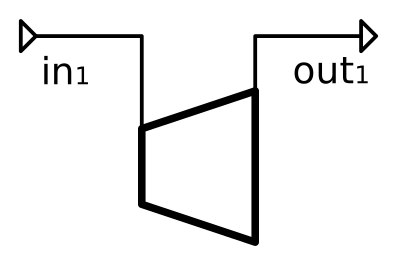
- class tespy.components.turbomachinery.steam_turbine.SteamTurbine(label, **kwargs)[source]
Bases:
TurbineClass for steam turbines with wet expansion.
Mandatory Equations
fluid:
tespy.components.component.Component.variable_equality_structure_matrix()mass flow:
tespy.components.component.Component.variable_equality_structure_matrix()
Optional Equations
tespy.components.turbomachinery.base.Turbomachine.energy_balance_func()tespy.components.turbomachinery.steam_turbine.SteamTurbine.eta_s_wet_func()tespy.components.turbomachinery.turbine.Turbine.eta_s_func()tespy.components.turbomachinery.turbine.Turbine.eta_s_char_func()
Inlets/Outlets
in1
out1
Optional outlets
power
Image

- Parameters:
label (str) – The label of the component.
design (list) – List containing design parameters (stated as String).
offdesign (list) – List containing offdesign parameters (stated as String).
design_path (str) – Path to the components design case.
local_offdesign (boolean) – Treat this component in offdesign mode in a design calculation.
local_design (boolean) – Treat this component in design mode in an offdesign calculation.
char_warnings (boolean) – Ignore warnings on default characteristics usage for this component.
printout (boolean) – Include this component in the network’s results printout.
P (float, dict) – Power, \(P/\text{W}\)
eta_s (float, dict) – Isentropic efficiency, \(\eta_s/1\)
eta_s_dry (float, dict) – Dry isentropic efficiency, \(\eta_s/1\)
alpha (float, dict) – Influence factor on wetness efficiency modifier, \(\alpha/1\)
pr (float, dict) – Outlet to inlet pressure ratio, \(pr/1\)
dp (float, dict) – Inlet to outlet pressure difference, \(dp/\text{p}_\text{unit}\) Is specified in the Network’s pressure unit
eta_s_char (tespy.tools.characteristics.CharLine, dict) – Characteristic curve for isentropic efficiency, provide CharLine as function
func.cone (dict) – Apply Stodola’s cone law (works in offdesign only).
Example
A steam turbine expands 10 kg/s of superheated steam at 550 °C and 110 bar to 0,5 bar at the outlet. For example, it is possible to calulate the power output and vapour content at the outlet for a given isentropic efficiency. The
SteamTurbineclass follows the implementation of the Baumann rule [33]>>> from tespy.components import Sink, Source, SteamTurbine >>> from tespy.connections import Connection >>> from tespy.networks import Network >>> nw = Network(iterinfo=False) >>> nw.units.set_defaults(**{ ... "pressure": "bar", "temperature": "degC", "enthalpy": "kJ/kg" ... }) >>> si = Sink('sink') >>> so = Source('source') >>> st = SteamTurbine('steam turbine') >>> inc = Connection(so, 'out1', st, 'in1') >>> outg = Connection(st, 'out1', si, 'in1') >>> nw.add_conns(inc, outg)
In design conditions the isentropic efficiency is specified. >>> st.set_attr(eta_s=0.9) >>> inc.set_attr(fluid={‘water’: 1}, m=10, T=250, p=20) >>> outg.set_attr(p=0.1) >>> nw.solve(‘design’) >>> round(st.P.val, 0) -7471296.0 >>> round(outg.x.val, 3) 0.821
To capture the effect of liquid drop-out on the isentropic efficiency, the dry turbine efficiency is specified >>> st.set_attr(eta_s=None) >>> st.set_attr(eta_s_dry=0.9, alpha=1.0) >>> nw.solve(‘design’) >>> round(st.P.val, 0) -7009682.0 >>> round(outg.x.val, 3) 0.84
- eta_s_wet_func()[source]
Equation for given dry isentropic efficiency of a turbine under wet expansion.
- Returns:
residual (float) – Residual value of equation.
\[ \begin{align}\begin{aligned}0 = -\left( h_{out} - h_{in} \right) + \left( h_{out,s} - h_{in} \right) \cdot \eta_{s,e}\\\eta_{s,e} = \eta_{s,e}^{dry} \cdot \left( 1 - \alpha \cdot y_m \right)\\y_m = \frac{\left( 1-x_{in}\right)+ \left( 1-x_{out} \right)}{2}\end{aligned}\end{align} \]
- initialise_source(c, key)[source]
Return a starting value for pressure and enthalpy at outlet.
- Parameters:
c (tespy.connections.connection.Connection) – Connection to perform initialisation on.
key (str) – Fluid property to retrieve.
- Returns:
val (float) – Starting value for pressure/enthalpy in SI units.
tespy.components.turbomachinery.turbine module
Module of class Turbine.
This file is part of project TESPy (github.com/oemof/tespy). It’s copyrighted by the contributors recorded in the version control history of the file, available from its original location tespy/components/turbomachinery/turbine.py
SPDX-License-Identifier: MIT
- class tespy.components.turbomachinery.turbine.Turbine(label, **kwargs)[source]
Bases:
TurbomachineClass for gas or steam turbines.
Mandatory Equations
fluid:
tespy.components.component.Component.variable_equality_structure_matrix()mass flow:
tespy.components.component.Component.variable_equality_structure_matrix()
Optional Equations
tespy.components.turbomachinery.base.Turbomachine.energy_balance_func()tespy.components.turbomachinery.turbine.Turbine.eta_s_func()tespy.components.turbomachinery.turbine.Turbine.eta_s_char_func()
Inlets/Outlets
in1
out1
Optional outlets
power
Image
- Parameters:
label (str) – The label of the component.
design (list) – List containing design parameters (stated as String).
offdesign (list) – List containing offdesign parameters (stated as String).
design_path (str) – Path to the components design case.
local_offdesign (boolean) – Treat this component in offdesign mode in a design calculation.
local_design (boolean) – Treat this component in design mode in an offdesign calculation.
char_warnings (boolean) – Ignore warnings on default characteristics usage for this component.
printout (boolean) – Include this component in the network’s results printout.
P (float, dict) – Power, \(P/\text{W}\)
eta_s (float, dict) – Isentropic efficiency, \(\eta_s/1\)
pr (float, dict) – Outlet to inlet pressure ratio, \(pr/1\)
dp (float, dict) – Inlet to outlet pressure difference, \(dp/\text{p}_\text{unit}\) Is specified in the Network’s pressure unit
eta_s_char (tespy.tools.characteristics.CharLine, dict) – Characteristic curve for isentropic efficiency, provide CharLine as function
func.cone (dict) – Apply Stodola’s cone law (works in offdesign only).
Example
A steam turbine expands 10 kg/s of superheated steam at 550 °C and 110 bar to 0,5 bar at the outlet. For example, it is possible to calulate the power output and vapour content at the outlet for a given isentropic efficiency.
>>> from tespy.components import Sink, Source, Turbine
>>> from tespy.connections import Connection
>>> from tespy.networks import Network
>>> from tespy.tools import ComponentCharacteristics as dc_cc
>>> import os
>>> nw = Network(iterinfo=False)
>>> nw.units.set_defaults(**{
...     "pressure": "bar", "temperature": "degC", "enthalpy": "kJ/kg",
...     "mass_flow": "t/h"
... })
>>> si = Sink('sink')
>>> so = Source('source')
>>> t = Turbine('turbine')
>>> inc = Connection(so, 'out1', t, 'in1')
>>> outg = Connection(t, 'out1', si, 'in1')
>>> nw.add_conns(inc, outg)
In design conditions the isentropic efficiency is specified. For offdesign a characteristic function will be applied, together with Stodola’s cone law coupling the turbine mass flow to inlet pressure.
>>> t.set_attr(eta_s=0.9, design=['eta_s'],
... offdesign=['eta_s_char', 'cone'])
>>> inc.set_attr(fluid={'water': 1}, m=36, T=550, p=110, design=['p'])
>>> outg.set_attr(p=0.5)
>>> nw.solve('design')
>>> nw.save('tmp.json')
>>> round(t.P.val, 0)
-10452574.0
>>> round(outg.x.val, 3)
0.914
>>> inc.set_attr(m=28.8)
>>> nw.solve('offdesign', design_path='tmp.json')
>>> round(t.eta_s.val, 3)
0.898
>>> round(inc.p.val, 1)
88.6
>>> os.remove('tmp.json')
- cone_func()[source]
Equation for stodolas cone law.
- Returns:
residual (float) – Residual value of equation.
\[0 = \frac{\dot{m}_{in,ref} \cdot p_{in}}{p_{in,ref}} \cdot \sqrt{\frac{p_{in,ref} \cdot v_{in}}{p_{in} \cdot v_{in,ref}}} \cdot \sqrt{\frac{1 - \left(\frac{p_{out}}{p_{in}} \right)^{2}} {1 - \left(\frac{p_{out,ref}}{p_{in,ref}} \right)^{2}}} - \dot{m}_{in}\]
- convergence_check()[source]
Perform a convergence check.
Note
Manipulate enthalpies/pressure at inlet and outlet if not specified by user to match physically feasible constraints.
- energy_connector_balance_func()[source]
(optional) energy balance equation connecting the power connector to the component’s power
- Returns:
residual (float) – Residual value of equation
\[0=\dot E + \dot{m}_{in}\cdot\left(h_{out}-h_{in}\right)\]
- eta_s_char_func()[source]
Equation for given isentropic efficiency characteristic.
- Returns:
residual (float) – Residual value of equation.
\[0 = - \left( h_\mathrm{out} - h_\mathrm{in} \right) + \eta_\mathrm{s,design} \cdot f\left( expr \right) \cdot \left(h_\mathrm{out,s}-h_\mathrm{in}\right)\]
- eta_s_deriv(increment_filter, k, dependents=None)[source]
Partial derivatives for isentropic efficiency function.
- Parameters:
increment_filter (ndarray) – Matrix for filtering non-changing variables.
k (int) – Position of derivatives in Jacobian matrix (k-th equation).
- eta_s_func()[source]
Equation for given isentropic efficiency of a turbine.
- Returns:
residual (float) – Residual value of equation.
\[0 = -\left( h_{out} - h_{in} \right) + \left( h_{out,s} - h_{in} \right) \cdot \eta_{s,e}\]
- exergy_balance(T0)[source]
Calculate exergy balance of a turbine.
- Parameters:
T0 (float) – Ambient temperature T0 / K.
Note
\[ \begin{align}\begin{aligned}\begin{split} \dot{E}_\mathrm{P} = \begin{cases} -P & T_\mathrm{in}, T_\mathrm{out} \geq T_0\\ -P + \dot{E}_\mathrm{out}^\mathrm{T} & T_\mathrm{in} > T_0 \geq T_\mathrm{out}\\ -P +\dot{E}_\mathrm{out}^\mathrm{T}- \dot{E}_\mathrm{in}^\mathrm{T} & T_0 \geq T_\mathrm{in}, T_\mathrm{out}\\ \end{cases}\end{split}\\\begin{split}\dot{E}_\mathrm{F} = \begin{cases} \dot{E}_\mathrm{in}^\mathrm{PH} - \dot{E}_\mathrm{out}^\mathrm{PH} & T_\mathrm{in}, T_\mathrm{out} \geq T_0\\ \dot{E}_\mathrm{in}^\mathrm{T} + \dot{E}_\mathrm{in}^\mathrm{M} - \dot{E}_\mathrm{out}^\mathrm{M} & T_\mathrm{in} > T_0 \geq T_\mathrm{out}\\ \dot{E}_\mathrm{in}^\mathrm{M} - \dot{E}_\mathrm{out}^\mathrm{M} & T_0 \geq T_\mathrm{in}, T_\mathrm{out}\\ \end{cases}\end{split}\\\dot{E}_\mathrm{bus} = -P\end{aligned}\end{align} \]
- static initialise_source(c, key)[source]
Return a starting value for pressure and enthalpy at outlet.
- Parameters:
c (tespy.connections.connection.Connection) – Connection to perform initialisation on.
key (str) – Fluid property to retrieve.
- Returns:
val (float) – Starting value for pressure/enthalpy in SI units.
- static initialise_target(c, key)[source]
Return a starting value for pressure and enthalpy at inlet.
- Parameters:
c (tespy.connections.connection.Connection) – Connection to perform initialisation on.
key (str) – Fluid property to retrieve.
- Returns:
val (float) – Starting value for pressure/enthalpy in SI units.
tespy.components.turbomachinery.turbocompressor module
Module of class TurboCompressor.
This file is part of project TESPy (github.com/oemof/tespy). It’s copyrighted by the contributors recorded in the version control history of the file, available from its original location tespy/components/turbomachinery/turbocompressor.py
SPDX-License-Identifier: MIT
- class tespy.components.turbomachinery.turbocompressor.TurboCompressor(label, **kwargs)[source]
Bases:
CompressorClass for a turbocompressor.
Mandatory Equations
fluid:
tespy.components.component.Component.variable_equality_structure_matrix()mass flow:
tespy.components.component.Component.variable_equality_structure_matrix()
Optional Equations
tespy.components.turbomachinery.base.Turbomachine.energy_balance_func()tespy.components.turbomachinery.compressor.Compressor.eta_s_func()tespy.components.turbomachinery.turbocompressor.TurboCompressor.char_map_eta_s_func()tespy.components.turbomachinery.turbocompressor.TurboCompressor.char_map_pr_func()
Inlets/Outlets
in1
out1
Optional inlets
power
Image
- Parameters:
label (str) – The label of the component.
design (list) – List containing design parameters (stated as String).
offdesign (list) – List containing offdesign parameters (stated as String).
design_path (str) – Path to the components design case.
local_offdesign (boolean) – Treat this component in offdesign mode in a design calculation.
local_design (boolean) – Treat this component in design mode in an offdesign calculation.
char_warnings (boolean) – Ignore warnings on default characteristics usage for this component.
printout (boolean) – Include this component in the network’s results printout.
P (float, dict) – Power, \(P/\text{W}\)
eta_s (float, dict) – Isentropic efficiency, \(\eta_s/1\)
pr (float, dict) – Outlet to inlet pressure ratio, \(pr/1\)
dp (float, dict) – Inlet to outlet pressure difference, \(dp/\text{p}_\text{unit}\) Is specified in the Network’s pressure unit
char_map_pr (tespy.tools.characteristics.CharMap, dict) – Characteristic map for pressure ratio vs. nondimensional mass flow.
char_map_eta_s (tespy.tools.characteristics.CharMap, dict) – Characteristic map for isentropic efficiency vs. nondimensional mass flow.
igva (float, dict,
"var") – Inlet guide vane angle, \(igva/^\circ\).
Example
Create an air compressor model and calculate the power required for compression of 50 l/s of ambient air to 5 bars. Using a generic compressor map how does the efficiency change in different operation mode (e.g. 90 % of nominal volumetric flow)?
>>> from tespy.components import Sink, Source, TurboCompressor
>>> from tespy.connections import Connection
>>> from tespy.networks import Network
>>> import os
>>> nw = Network(iterinfo=False)
>>> nw.units.set_defaults(**{
...     "pressure": "bar", "temperature": "degC", "volumetric_flow": "l/s",
...     "enthalpy": "kJ/kg"
... })
>>> si = Sink('sink')
>>> so = Source('source')
>>> comp = TurboCompressor('compressor')
>>> inc = Connection(so, 'out1', comp, 'in1')
>>> outg = Connection(comp, 'out1', si, 'in1')
>>> nw.add_conns(inc, outg)
Specify the compressor parameters: nominal efficiency and pressure ratio. For offdesign mode the characteristic map is selected instead of the isentropic efficiency. For offdesign, the inlet guide vane angle should be variable in order to maintain the same pressure ratio at a different volumetric flow.
>>> comp.set_attr(
...     pr=5, eta_s=0.8, design=['eta_s'],
...     offdesign=['char_map_pr', 'char_map_eta_s']
... )
>>> inc.set_attr(fluid={'air': 1}, p=1, T=20, v=50)
>>> nw.solve('design')
>>> nw.save('tmp.json')
>>> round(comp.P.val, 0)
12772.0
>>> round(comp.eta_s.val, 2)
0.8
>>> inc.set_attr(v=45)
>>> comp.set_attr(igva='var')
>>> nw.solve('offdesign', design_path='tmp.json')
>>> round(comp.eta_s.val, 2)
0.77
>>> round(comp.igva.val, 2)
8.88
Or, we can fix the inlet guide vane angle and under the given pressure ratio the volumetric flow is a result. Note, that the problem can be very sensitive to changes of
igva.>>> comp.set_attr(igva=10) >>> inc.set_attr(v=None) >>> nw.solve('offdesign', design_path='tmp.json') >>> nw.assert_convergence() >>> round(inc.v.val, 2) 44.31 >>> os.remove('tmp.json')
- char_map_eta_s_func()[source]
Calculate isentropic efficiency from characteristic map.
- Returns:
residual (float) – Residual value of equation.
Note
X: speedline index (rotational speed is constant)
Y: nondimensional mass flow
igva: variable inlet guide vane angle for value manipulation according to [32].
\[\begin{split}X = \sqrt{\frac{T_\mathrm{in,design}}{T_\mathrm{in}}}\\ Y = \frac{\dot{m}_\mathrm{in} \cdot p_\mathrm{in,design}} {\dot{m}_\mathrm{in,design} \cdot p_\mathrm{in} \cdot X}\\ \vec{Y} = f\left(X,Y\right)\cdot\left(1-\frac{igva}{100}\right)\\ \vec{Z}=f\left(X,Y\right)\cdot\left(1-\frac{igva^2}{10000}\right)\\ 0 = \frac{\eta_\mathrm{s}}{\eta_\mathrm{s,design}} - f\left(Y,\vec{Y},\vec{Z}\right)\end{split}\]
- char_map_pr_func()[source]
Calculate pressure ratio from characteristic map.
- Returns:
residual (float) – Residual value of equations.
Note
X: speedline index (rotational speed is constant)
Y: nondimensional mass flow
igva: variable inlet guide vane angle for value manipulation according to [32].
\[\begin{split}X = \sqrt{\frac{T_\mathrm{in,design}}{T_\mathrm{in}}}\\ Y = \frac{\dot{m}_\mathrm{in} \cdot p_\mathrm{in,design}} {\dot{m}_\mathrm{in,design} \cdot p_\mathrm{in} \cdot X}\\ \vec{Y} = f\left(X,Y\right)\cdot\left(1-\frac{igva}{100}\right)\\ \vec{Z} = f\left(X,Y\right)\cdot\left(1-\frac{igva}{100}\right)\\ 0 = \frac{p_{out} \cdot p_{in,design}} {p_\mathrm{in} \cdot p_\mathrm{out,design}}- f\left(Y,\vec{Y},\vec{Z}\right)\end{split}\]